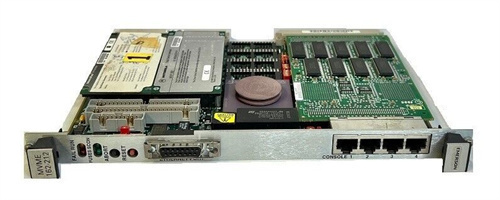
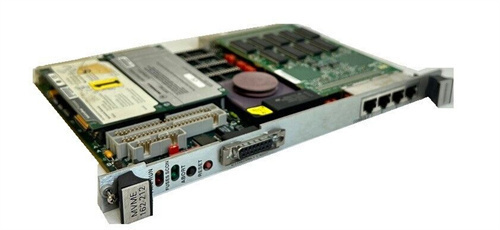
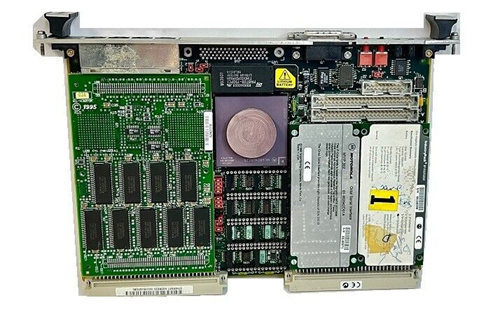
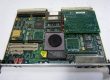
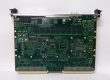
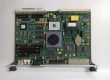
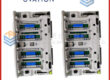
Robust Design The MVME162 – 022A is designed with a sturdy metal case, which provides protection against dust, moisture, and mechanical vibrations. This makes it suitable for use in harsh industrial environments.
Quality Components It uses high – quality electronic components and undergoes strict quality testing during the manufacturing process, ensuring long – term stability and reliability.
Fault – Tolerant Design The design of the MVME162 – 022A includes built – in fault – tolerance mechanisms, such as error – correction codes in the memory and redundant communication paths, which can prevent system failures in case of component malfunctions.
6. Real – World Examples
Automotive Assembly Line In an automotive factory, the MVME162 – 022A was installed to control a robotic welding station. The module received signals from position sensors to ensure the correct positioning of the welding torch. One day, a sensor malfunctioned, and the MVME162 – 022A detected the abnormal signal. It immediately stopped the welding process and sent an alarm to the control center, preventing potential welding defects and equipment damage.
Power Substation Monitoring At a power substation, the MVME162 – 022A was used to monitor the voltage and current levels of the power lines. During a sudden power surge, the module quickly detected the change in voltage and sent a control signal to the circuit breaker to disconnect the faulty section, protecting the power grid from further damage.
In automotive manufacturing plants, the MVME162 – 022A can be used to control the movement of robotic arms on the assembly line. It receives signals from position sensors on the robots and sends control signals to the motors, ensuring precise and efficient assembly operations.
In food processing industries, it can monitor and control the filling and packaging processes. By interfacing with sensors that measure the weight and level of products, it can adjust the filling speed and packaging parameters to ensure consistent product quality.
Power Generation and Distribution In power plants, the MVME162 – 022A can be used for monitoring and controlling the operation of generators. It can collect data from sensors measuring parameters such as voltage, current, and temperature, and take appropriate actions to maintain stable power generation.
Telecommunications It can be used in telecommunications equipment for signal processing and control. For example, it can manage the routing of signals in a communication network by monitoring the status of network nodes and making real – time decisions.
3. Weight and Dimensions
Weight The MVME162 – 022A weighs approximately 1.2 kg, which is relatively light and easy to handle during installation and maintenance.
Dimensions It has dimensions of approximately 160 mm in length, 100 mm in width, and 30 mm in height. Its compact size allows it to be easily installed in standard VMEbus chassis.
4. Features
High – Performance Processor The Motorola 68040 processor provides sufficient computing power for handling complex control and monitoring tasks, enabling real – time data processing and decision – making.
Versatile I/O Interfaces The combination of digital I/O, serial ports, and VMEbus interface makes it suitable for a wide range of applications and easy to integrate with other devices and systems.
Expandable Memory The ability to expand the on – board memory allows for storing more data and running more complex software programs, enhancing the system’s functionality.
Power Supply The MVME162 – 022A operates on a 5V DC power supply, with an allowable voltage range from 4.75V to 5.25V. It consumes approximately 15 – 20W of power during normal operation, ensuring stable performance within the specified voltage range.
Processor and Memory It is equipped with a Motorola 68040 processor running at a clock speed of up to 40 MHz. The system has 4 MB of on – board static RAM, which can be expanded to 16 MB. Additionally, it features 512 KB of EPROM for storing the boot code and essential system software.
I/O Interfaces
Digital Inputs/Outputs: It has 16 digital input channels and 16 digital output channels. These can be used to interface with various digital sensors and actuators, such as limit switches, proximity sensors, and relays.
Serial Ports: There are two serial ports (RS – 232), which support communication rates up to 115.2 kbps. These ports can be used for connecting to other devices like modems, barcode readers, or other serial – enabled instruments.
VME Bus Interface: The MVME162 – 022A is designed to be used in a VMEbus system. It supports both master and slave modes on the VMEbus, allowing for high – speed data transfer and communication with other VME – compatible modules.
Resolution and Accuracy The digital I/O signals have a response time of less than 100 microseconds, ensuring fast and accurate control and monitoring of external devices.