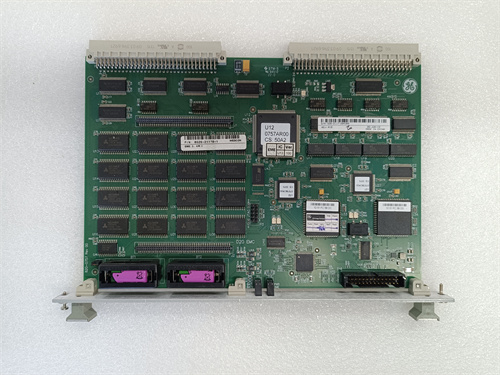
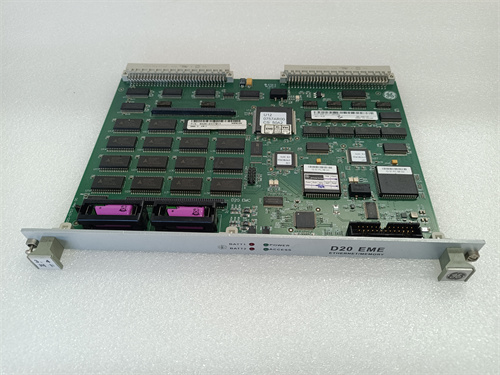
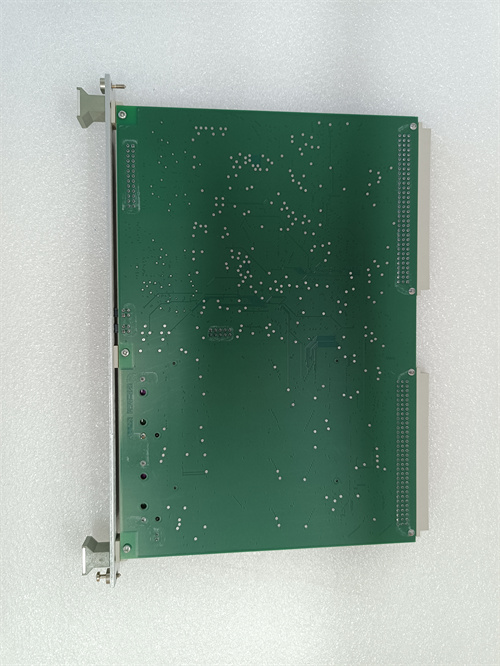
Description
Product Parameters
- Processor: High-performance 32-bit microcontroller
- Memory: Integrated Flash memory for firmware and application storage; typically supports up to 16 MB of battery-backed SRAM
- Communication Ports:
- Multiple serial ports (RS-232/RS-485) for legacy device integration
- Integrated Ethernet port for IEC 61850, DNP3, and Modbus TCP/IP
- Power Supply: Typically operates on 24/48 VDC or 125/250 VDC/VAC (depending on baseplate configuration)
- Protocol Support: DNP3 (Serial and LAN/WAN), IEC 61850 (MMS/GOOSE), Modbus RTU/TCP, and proprietary GE protocols
- Operating Temperature: 40°C to +85°C (industrial rated)
Advantages and Features
- Modular Scalability: The GE D20 EME fits seamlessly into the D20 chassis, allowing users to mix and match I/O modules (such as D20S, D20A, D20K) without needing a separate controller for each rack.
- Cybersecurity Ready: Features built-in secure authentication for DNP3, supporting role-based access control (RBAC) to comply with NERC CIP standards.
- High Availability: Supports redundant power supplies and communication paths, ensuring zero-single-point-of-failure operation in critical substations.
- IEC 61850 Compliance: Native support for GOOSE messaging and MMS, enabling modern digital substation architectures without requiring external protocol converters.
Application Cases
- Substation Automation (SAS): Used by major utilities to aggregate data from protection relays (e.g., GE Multilin) and control circuit breakers via a single unit, reducing wiring complexity by 60% compared to hardwired RTUs.
- Distribution Automation (DA): Implemented in feeder automation schemes where the GE D20 EME executes local logic (such as loop restoration) without relying on the master SCADA, ensuring <2-second isolation times during faults.
- Oil & Gas Pipelines: Deployed in remote pumping stations to manage high-speed shutdown sequences and leak detection algorithms due to its wide temperature tolerance and deterministic processing.
Comparison with Competing Products
- vs. Siemens SICAM A8000: While the Siemens unit excels in compact footprint for grid edge applications, the offers superior legacy I/O expansion capabilities. The D20’s distributed I/O architecture allows for more cost-effective wiring in large switchyards compared to the centralized architecture of the SICAM.
- vs. Schweitzer Engineering Laboratories (SEL) 2240: The SEL 2240 focuses heavily on high-speed logic (Axion). In contrast, the GE D20 EME provides a richer set of legacy serial protocols (multiple RS-232/485 ports native), making it the preferred choice for brownfield substation retrofits where connecting older electromechanical relays is necessary.
Selection Suggestions
- Determine Communication Requirements: If you require dual-redundant Ethernet for high availability, ensure your chassis configuration supports the specific variant with dual NICs.
- I/O Count: The D20 EME supports distributed I/O over fiber. Calculate your total point count. If you are exceeding 2000 I/O points, consider using the D20 EME as a master in a multi-dropped configuration.
- Power Source: Verify whether your substation DC supply is 48V or 125V. The baseplate (backplane) determines voltage compatibility for the GE D20 EME, not the module itself.
Precautions
- Firmware Compatibility: When replacing an existing unit, verify that the firmware version on the new matches the existing project database. Firmware mismatches can cause configuration file corruption during uploads.
- Grounding: Strict adherence to the single-point grounding scheme outlined in the GE D20 installation manual is mandatory. Improper grounding can lead to intermittent communication resets due to transient surges common in substation environments.
- Battery Maintenance: The GE D20 EME relies on an internal battery to maintain SRAM during power loss. Ensure this battery is checked or replaced during routine maintenance (typically every 5-7 years) to prevent loss of runtime logic and time-stamped data.
 GE DS200CVMAG1A GE DS200CVMAG3A GE DS200DACAG1A GE DS200DCFBF1AAB GE DS200DCFBG1B DS200DCPAG1A GE DS200DCVAG1A GE